I am writing a research paper for my technology class and I chose to base it around the advancements in the CAM/ rapid prototyping field related to jewelry and small object design. I'm in the process of assembling references so I thought I'd just throw them up here. I welcome anyone to suggest other sites, books, or magazines that might help me. Thanks!
Shapeways Blog
Shapeways Gallery
NY Times Article
i.materialise Blog
Freedom of Creation (my new favorite website)
Dimension Printing Company
DesktopFactory Printers
Wednesday, September 29, 2010

Wednesday, September 22, 2010
Die Forming for Fun
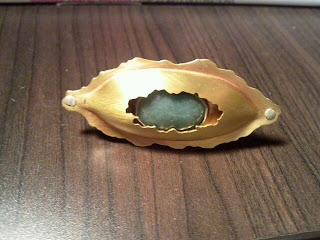
This is a ring I made Thursday night. I just had an idea in my head and I couldn't get past it until I made it. I gave myself three hours to just crank it out so I could move past it. The craftsmanship is dreadful but I still like the ring as a concept. I just pushed through it and didn't look back. It's a nice study of die forming, if nothing else. It's got a nice weight and sturdiness to it. Maybe one day I will make a better version.


Thursday, September 16, 2010
Lovely Forms
These are my almond forms I have been making with the hydraulic press this week. I really love them. They have a great weight in your hand and I just love the color of brass. They seem to me like a somewhat elegant form of coinage.

Monday, September 13, 2010
Late Night in the Studio
I spent all of Thursday afternoon and evening in the studio working on making the necessary die-formed samples for Tuesday's class. The studio was full of dedicated workers and it was certainly an exhausting night.
 My 8 pressed forms and my pressure records.
 Jess hard at work soldering her forms together.


Tuesday, August 31, 2010
Thoughts on Containers
Containers can be made to fit a specific item and that item only or they can be made for many items and as more of an organizational ploy. Containers are also often misused in the place of the specific container needed to satisfy one's purposes. I was doing some free thought on what it means to be a container when I realized that this all depends on what is being contained and, more importantly, why it is being contained. I listed out some purposes to this effect and landed on three main reasons why something would be contained.
The first reason, and the most obvious, is for pure organizational purposes. This can be to separate items for ease of access or it can be to aid in the distribution of the item, such as a mustard bottle. This is the most product oriented section. Some items I listed in this category were books, trays, soap bottles, computers, tape dispensers, batteries, cameras, and hair clips.
The second reason an item would be contained is if it were precious in some way, may this be for sentimental reasons or that the contained is simply fragile or expensive. These items are highly valued in some way, such that we would use the container as a means of protection from the world. Some items I listed in this category were money, photographs, jewelry, gadgets, gems, and children.
The last reason an item would be contained is if it were possible harmful to the world. These items may or may not be highly valued but we give them containment to protect the world from the contained. Some items I listed in this category were medical waste, electrical outlets, guns, blades, and liquor. It seems that the main reasons to contain an item are to protect it, to protect us, or simply to organize said item.
The first reason, and the most obvious, is for pure organizational purposes. This can be to separate items for ease of access or it can be to aid in the distribution of the item, such as a mustard bottle. This is the most product oriented section. Some items I listed in this category were books, trays, soap bottles, computers, tape dispensers, batteries, cameras, and hair clips.
The second reason an item would be contained is if it were precious in some way, may this be for sentimental reasons or that the contained is simply fragile or expensive. These items are highly valued in some way, such that we would use the container as a means of protection from the world. Some items I listed in this category were money, photographs, jewelry, gadgets, gems, and children.
The last reason an item would be contained is if it were possible harmful to the world. These items may or may not be highly valued but we give them containment to protect the world from the contained. Some items I listed in this category were medical waste, electrical outlets, guns, blades, and liquor. It seems that the main reasons to contain an item are to protect it, to protect us, or simply to organize said item.
Container Inspiration
I went around and photographed 24 inspiring containers and uploaded them to flickr with short descriptions here
Monday, May 17, 2010
Finito!
We are done with our Chairarium! I am so pleased with how it turned out. All of our sweat and tears were for a great cause. The chair looks great and it's completely modular. It is structurally sounds, aesthetically pleasing, and wonderful smelling! Awesome stuff.


Sunday, May 16, 2010

Friday, May 14, 2010
Jewelry Project II Reflection

 "Swimming with Stingrays"
materials: copper sheet and wire, brass sheet, silver sheet, resin
I really love how this piece turned out. It experienced many face lifts, both in the design and the process. My original plan was to have the shape be the stingray body facing down with the tail going straight up. This would have been hung like a classic pendant. I then decided to bring the tail to the side and add a detached spash up the chain to the other side to add interest but maintain balance. From this design I moved the clasping mechanism down into the decorative area to incorporate it into the design. It is now located between the main piece and the secondary splash. This makes the piece a bit difficult to put on but I really think it is worth it not to have an ugly clasp on the back of the chain. From that design I decided to remove the resin from the equation because I thought it would bring down the piece and make it look gaudy. I turned in the piece like this but then was encouraged to add the resin and the internal pierced stingray to make the brass side of the pendant more developed. I fought this notion for a while but eventually gave in when I realized that I considered the brass side to be the "back" of the piece and it needed a major change to make it worthy of facing out from the body. I decided to just take the risk and go back to my original plan with the resin and I believe this greatly improved the piece. I laid down a thin, dark layer of resin in the piece, let it set, and then place the pierced stingray atop this layer. I then mixed a lightly colored batch of resin and flowed it over the stingray. I overfilled the piece on purpose so that a bit of resin would leak out from under the brass. This highlighted the splash form and related the shiny resin into the rest of the piece. I think that is my favorite aspect of the piece. It's unique and very applicable to my theme.
I am also very pleased with the interplay between the size of the repoussed stingray and the wild, intricate flange. I tried to incorporate many elements (3D form, 2D figure, abnormal outline, multiple metals, non metal element, etc) to create one harmonious piece with a clear story. There certainly are flaws in the piece. I'm still not completely sold on the chain. I enjoy the repetition and interest it adds the the piece but it very very easily gets tangled and a black cord might highlight the piece more. Plus I may have just accidentally super glued the thing into a giant clump while I was writing this reflection. That's what I get for multitasking. You have to be careful where you set stuff down in my room. But anywho, that aspect of this piece is not tied down by any means. I think that is the only thing holding me back from enjoying it completely. Overall, though, I am very pleased with how this project turned out. It certainly photographs nicely.
Thursday, May 13, 2010
project from HELL
Here's some photos from our last two days in the studio working on our materials project. We decided to just set aside all of our progress from before and start fresh with more accurate measurements and straighter cuts. It was definitely an improvement on the project but it added about 8 hours to our schedules.
 Hand sawing and filing the slits that we extended from our original design. We also made them a bit thinner for a more sturdy assembly.
 Happily assembling the chair at 2 in the morning after an exhausting day of muscle overuse and pvc inhalation.
 A fallen comrade: Elise's jacket caked with pvc powder.
 Finally applying color after cutting, slotting, checking, cleaning, taping, and priming each pipe. Much more work to go.
 Hand sawing and filing the slits that we extended from our original design. We also made them a bit thinner for a more sturdy assembly.
 Happily assembling the chair at 2 in the morning after an exhausting day of muscle overuse and pvc inhalation.
  A fallen comrade: Elise's jacket caked with pvc powder.
 Finally applying color after cutting, slotting, checking, cleaning, taping, and priming each pipe. Much more work to go.
Monday, May 10, 2010


Sustainable Progress
This weekend I stole a ton of mint from my mom's garden (spearmint and applemint) to go in our Chairarium. My room smells fantastic. I also grabbed two cans of rustoleum to test out how the pvc takes spray paint. Should be a productive week.


Thursday, May 6, 2010


Monday, April 26, 2010
Materials Samples
My parents found a snake skin in the garage. This is normally bad news but it worked out great for me and my material samples. It was very fragile and dried out so I thought I would cut the largest intact piece I could and press it between two sheets of glass and solder around the outside. The scales are iridescent and it looks completely awesome.


Wednesday, April 21, 2010


Monday, April 19, 2010
Jewelry Project III

This is my maquette for our third project in J2. It's supposed to be based off of a historical period, people, and/or movement. It has to have a hollow form and a stone setting. The wings of this piece will be etched brass and the scarab will be a hollow repoussed form in copper. I hope to find a jade or lapis cabochon to set in silver at the focal point.
Cork is a magical material

I was online reading up on sustainable materials and I happened upon a description of cork and was amazed. I had no idea how awesome this substance is! Did you know you don't even have to kill the cork oak tree in order to harvest its cork? All you do is peel the bark off and the tree is left to regenerate. The average tree can be safely harvested every 9 to 12 years. Once processed, the cork can be used as a thermal insulator, an impermeable plug (wine cork), a floor material that is much better on joints, a flotation device, a slip-resistant surface, or interior decorating. Blows my mind!
http://sustainablematerials.com/cork/
Friday, April 16, 2010


Subscribe to:
Posts (Atom)